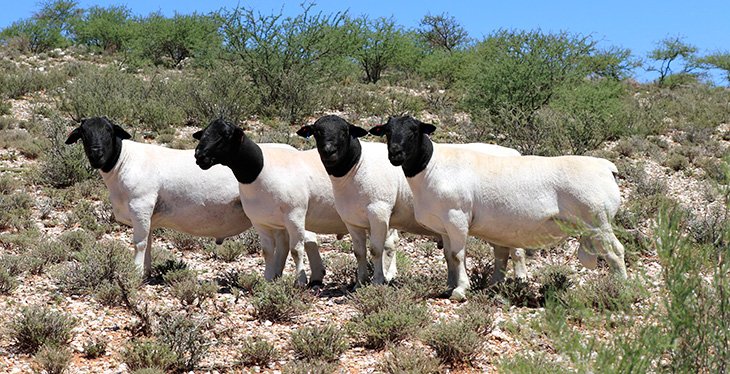
After the First World War, increased interest developed in South Africa in crossing indigenous sheep, like the Persian and Merino with British mutton breed rams. Due to the depression, surplus mutton and the slump in wool prices in the early 30’s, exporting mutton and lamb received more attention. To the English market, the fat-tail type sheep were strange and new, and not desirable according to their system of grading.
A need originates for good mutton sheep which could produce fast growing lambs on veld conditions with a good quality carcass. In the Western Cape, a prerequisite was that the ewes must be bred in November-December in order to lamb in April. In the Karoo areas, the aim was to replace the fat-tail types with a breed with a more acceptable carcass. The initial need was to produce a sheep breed suitable to the demanding low rainfall areas of the Northern Province. A relatively easy care sheep with an acceptable meat carcass had to be found for these difficult circumstances.
The most important characteristics required for the breed were:
• Satisfactory lambing ability in the autumn
• Reasonably acceptable meat carcass
• A good slaughter lamb on veld conditions at 4-5 months
• Resistance against cold wind and rain, extremely high summer temperatures and radiation
• A versatile sheep and good utilizer of tough grass and shrub veld
• Satisfactory reproductive fitness
• Easy care without lamb shearing problems
• Fair amount of colour and pigmentation
With this goal in mind, co-operative experiments were done by farmers on a small scale in the Karoo. Due to the outstanding performance of the Blackhead Persian, especially under harsh environmental conditions. This breed was selected as the mother breed. The Dorset Horn was selected for it demonstrated a longer breeding season in comparison to other British sheep breeds. (Reference: Dorper Sheep Breeders Society of South Africa’s website)
To determine the proportion of British mutton breed to introduce without losing the
hardiness of the indigenous breeds, they did the following:
• Used half-cross Dorset Horn x Persian rams (50:50) on the indigenous fat-tail
breeds in order to upgrade them to the half-cross Dorset Horn x Blackhead
Persian. This phase only started in 1941 as high prices, mortality and mating
ability of purebred British mutton breeds lead to their failure.
• Established an improved South African mutton breed. There were already
experiments taking place at Grootfontein with the Dorset x Persian proving more
and more to comply with the need for ewes to lamb in Autumn or to conceive in
November-December.
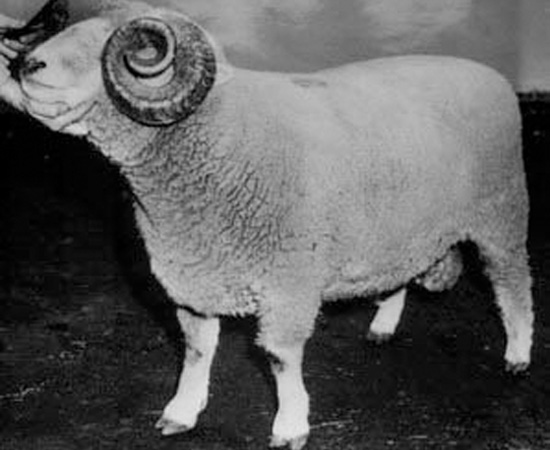
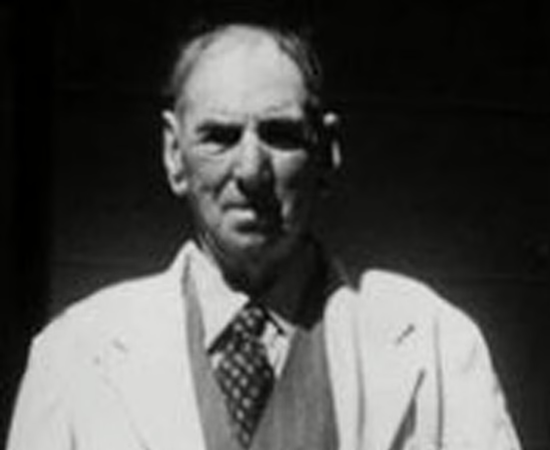
Later, ¼ and 3/8 cross were added and the Round-ribbed Afrikaner. Eventually in 1942, after some co-operators joined the half-cross rani and switched to the mating of F1-half-cross x F1-half-cross Dorset-Persian to produce F2-half-cross individuals. The following co-operators, namely R.Y. Edmeades, W.B. Ludick, W.A. Stahl, D.J de Smidt (and his son H.C. de Smidt) worked successfully with Dorset Horn crosses on their farms and contributed much to the establishment of the Dorper breed.
As the Dorper was developed on their farms under the guidance of D.J Engela, these
people devoted a lifetime’s work to the project, and not always under easy circumstances. Through trial and tribulations, Engela decided in 1942 that Edmeades should
strive to a half-cross Dorset x Persian. At that stage Edmeades did not have mature
half-cross rams available but he had quite a few ¾ bred on which he was previously
concentrating.
Engela selected two half-cross (Dorset x Persian) rams from the flock of Stahl to be
used by Edmeades. They were received in September 1942 but not put to work immediately although from then on he was concentrating on a half-cross Dorset x Persian.
He mated his ¾ cross DP rams the following mating season with Persian and 3/8 cross
DP ewes. The ¾ cross and 7/8 cross DP ewes and also some Persian ewes were mated
to a Dorset Horn ram.
The purpose of a Standard of Excellence is to indicate the degree of excellence of the
animal by means of a description and a score by points according to visual appearance and performance. These values must be recorded in such a way as to give a true reflection of the excellence or deficiencies of the sheep.
For descriptive and comparative purposes sheep may be compared with each other
according to a score card, and the following points are allotted, corresponding to
the respective terms of the main sections of the standard of excellence.
Head
Strong and long, with large eyes, widely spaced and protectively placed. Strong nose,
strong well-shaped mouth with well-fitted deep jaws. The forehead must not be
dished. The size of the ears must be in relation to the head. A developed horn base or
small horns are the ideal. Heavy horns are undesirable, but permissible. The head must
be covered with short, dullish black hair in the Dorper and dull, white hair in the White
Dorper. The head must be dry without indications of fat localization.
Fore-Quarter And Neck
The neck should be of medium length, well-fleshed and broad and well-coupled to the
forequarters. Shoulders should be firm, broad and strong. A moderate protrusion of
the brisket beyond the shoulders, moderate width and good depth are the ideal. Forelegs must be strong, straight and well-placed with strong pasterns and hoofs not too widely split. Weak pasterns and X legs must be discriminated against according to degree. Shoulders which appear loose; a brisket which slants up too sharply with no projection beyond the shoulders; crooked legs; and weak walking ability are all faulty.
Barrel
The ideal is a long, deep wide body, ribs well sprung, loin broad and full. The animal
must have a long straight back and not a “devil’s grip”. A slight dip behind the shoulders is permissible.
Hind-Quarter
A long and wide rump is the ideal. The inner and outer twist to be well fleshed and
deep in adult animals. The hind legs must be strong and well-placed, with sturdy feet
and strong pasterns. Faulty pasterns must be discriminated against according to
degree. The hocks must be strong without a tendency to turn in or out. Sickle, bandy.